- About
- Store
Loading...
At fairs like Art Basel, the booths are pristine and the talking points are polished, with a specific choreography moving through the days. However, beneath the surface sits something else: the fair is not just a marketplace for objects, but also a marketplace for outcomes – who gets seen and written about, who gets affirmed for shows later in the year, who gets many and/or high sales and who gets placed into the right sequence of rooms and conversations. People talk about taste and conviction, but the fair also runs on the overall distribution, timing, numbers, and visitors. All of that is precisely what Jack Butcher aims to make visible. “I like making things transparent.”
In January, we published a story about Self Checkout (2025) – Jack Butcher’s decision to make the receipt the artwork at Art Basel Miami in December, and to make the economics of the fair legible. The project was apparent in a literal way, taking the private arithmetic that surrounds art fairs and moving it into the public zone, where everyone could see the conditions of participation and decide what they wanted to do with them.
Now, with SILK bringing Butcher to Art Basel Hong Kong with WORK (2024), LUCK (2026) and PLAY (2026), the question shifts. Where Self Checkout externalized the booth’s balance sheet, this new project is poised to externalize something more intimate: the way we narrate success itself.
Why did Butcher choose this subject? “Because whenever money appears in art – especially in the art-fair ecosystem – two stories compete for the microphone,” he says. “One is the story of effort: time, craft, discipline, repetition, stamina, showing up. The other is the story of chance: timing, taste, networks, platform dynamics, what gets copied, what gets boosted, who happens to walk into the booth at the right minute.”
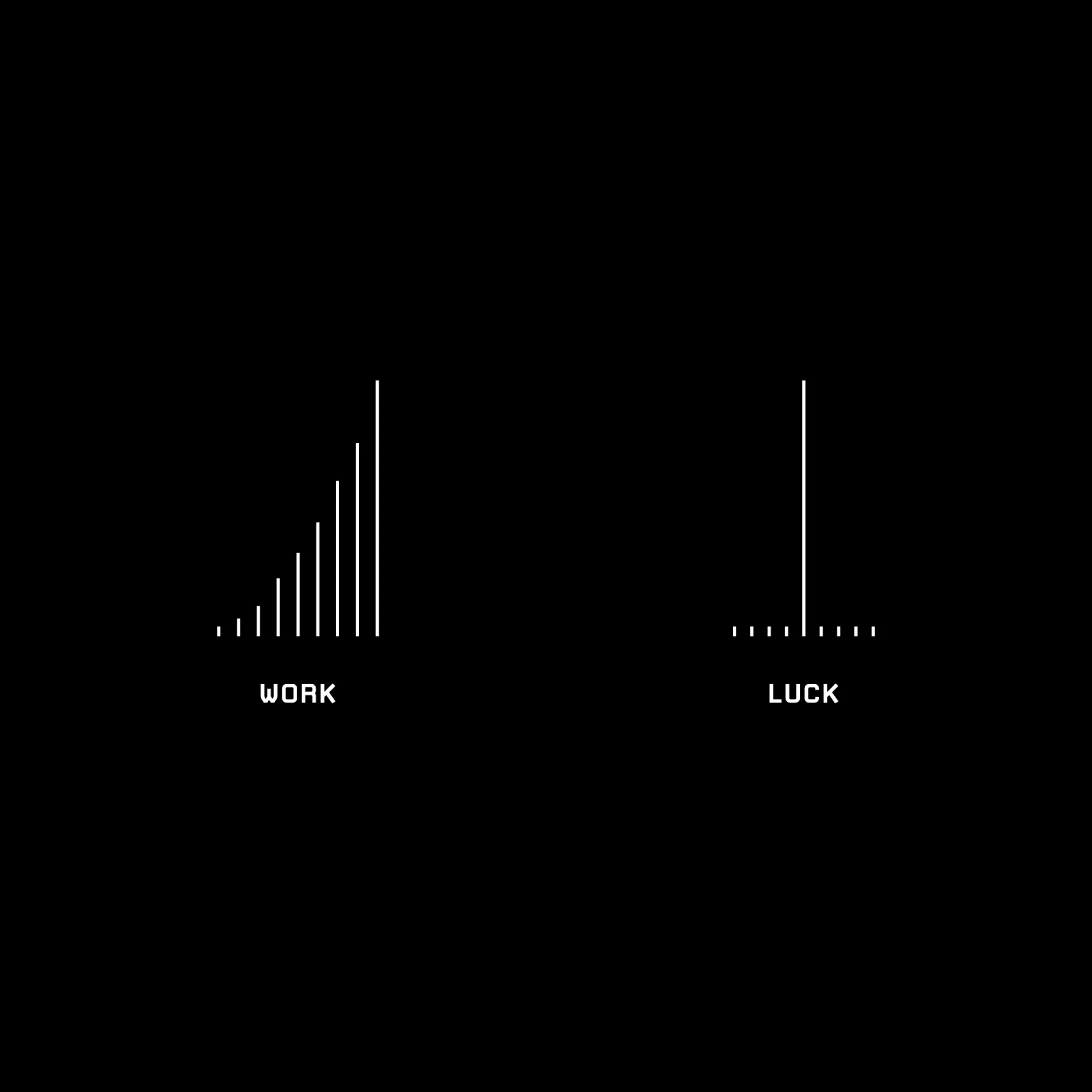
Butcher's idea is that people will insist on one story or the other depending on what they need to justify, like their price, their purchase, their status, and/or their disappointment. Butcher’s work has always lived inside that clash, partly because he has a designer’s instinct for systems, and partly because he refuses the comforting fiction that value is a natural property of things.
If you think he sounds somewhat unsentimental about value, it’s because he treats it as something engineered – built up through hours, repetition, narrative, and eventually recognition. When Butcher started with creating graphics under the name Visualize Value, it was basically him figuring out how the world works and turning those thoughts into artifacts. “Then it became weirdly clear to me that the narrative itself actually holds tons of value also,” he reflects. “It’s such a cumulative approach in the end: showing people over and over what your vision is, and if they resonate with that, they might want to be a part of it.”
With WORK, LUCK, PLAY, Butcher builds a sculptural system that treats the fair like a machine instead of a ‘neutral’ stage: a place where agency migrates away from visible gestures and into the structures that govern them.
In that regard, the project’s line definitely functions as a thesis: “Unless you own the whole system, you are just rolling the dice.”
This can be read as a description of how contemporary life increasingly feels – especially in the economies that sit between culture and finance, where “work” and “luck” are the two most convenient myths we use to explain why value lands where it lands.

WORK actually began as a digital artwork. In 2021, Butcher minted a sequence of four ‘sculptural’ hands – forms rendered in elemental matter against an infinite black void that reads at once as studio backdrop and cosmic screen. Hands are old symbols with a lot of meaning and function. In art history they have stood for touch (presence), skill (training), authorship (the signature, the gesture), and, more broadly, the proof of a human maker. They are also where labour becomes visible: the part of the body that holds and shapes.
Butcher’s hands trace a more contemporary lineage. Across the four stages, labour migrates from the embodied to the abstract: from tactile action, to simplified mechanics, to interface-driven gestures, concluding in a pixelated hand pointer derived from early Macintosh operating systems. “I wanted to document the evolution of labor, the body parts we use for producing, and the fidelity of the things we produce with it – changing over time,” the artist says. “The first hand is modeled on Michelangelo’s David, and in three steps this hand becomes more and more reduced to the mouse clicker at the end of the line.”
That story in itself – work becoming less physical, more mediated – is not new, but what is distinct here is the way Butcher treats it less as an image and more as a question of verification. In an economy where effort is increasingly invisible, what becomes the basis for belief? If you can’t see the work, you can’t easily argue with it. And when argument collapses, the systems that certify value – brands, institutions, ledgers, reputation – step in to do the persuading.


Butcher also pushes against a lazy hierarchy that still haunts digital practice: the idea that ‘physical’ equals ‘hard’, and therefore deserves more respect. He understands why that perception sticks – “cumulative effect of images… interpreted as low effort” – but he also insists that the labour simply migrates. Online, the struggle is not only making: it is surfacing. “It’s also hard to break through the noise in that environment. You need an activation in the network.” So in a way, that’s also ‘hard’ and who gets to say what’s ‘easier’?
Now, there is also a physical life of WORK. After the NFT was minted, Butcher was introduced to Asprey Studio in London to explore a translation in silver – an attempt to move a digitally native image of labour into a material with its own weight, history, technical constraints, craft conventions, and verification rituals.
That is where Butcher’s interest in ledgers becomes concrete. The work is cast in pure silver, turning the immaterial ‘click’ of a hand into something heavy. The early hand – high-fidelity, anatomically complete – carries the most obvious aura of artisanal labour: detail, attention, the craft of the made thing. The final hand, reduced to a cursor, looks almost embarrassingly simple by comparison. And yet the making doesn’t follow the visual hierarchy. “So actually, the mouse point was the hardest to produce in silver,” Butcher laughs. “Four times the amount of labour for that shape.” In other words: the most “digital-looking” form demanded the most difficult analog effort.
WORK points (literally) to the modern paradox: when work becomes digital, it can scale more easily. The ‘click hand’ can move more than the ‘real hand’ ever could. And still, the hand-made, most-detailed object of a hand now commands its own premium. To anchor that contradiction, WORK leans on another, older form of trust: institutional material verification. The first hand is hallmarked by the UK Assay Office and bears newly registered marks connected to the artist – a small bureaucratic act, but one that carries a lot of cultural weight.
Hallmarking is a centuries-old technology of proof, a public guarantee embedded into the object itself. Paired with Butcher’s digital practice, it creates an interesting collision of time scales: slow institutional trust alongside fast networked verification. In that sense, the sculpture doesn’t merely illustrate the evolution of labour; it stages the question of what counts as evidence when the most consequential forms of work leave almost no physical trace.
It was this compressed set of dynamics – translation, verification, and the way meaning mutates across formats – that drew SILK co-founders Dino and Ambar to the piece. They travelled to London to meet Butcher and Alistair Walker from Asprey and acquired the sculpture, intrigued by how much of the contemporary art economy it holds: the conversion of an on-chain image into a precious metal artifact, the friction between speed and craft, and the return of old-world proof – hallmarks, authorship, studio processes, material accountability, and certification – inside a practice often assumed to be immaterial.
Bringing WORK to Art Basel Hong Kong with SILK, then, is not just a matter of displaying a beautiful, silver, four-piece object. It is a chance to show a sculpture that carries its own history of negotiation – an artwork that does what Butcher’s best projects do: make the system visible, without pretending the system can be escaped.

What WORK also does, without spelling it out, is showing a gap in the system: labour and reward are not correlated in the way we like to pretend. Art markets are full of people who work obsessively and remain invisible, but also full of people who ‘catch a wave’ and maybe didn’t have to use their hands (pun intended) that much. Butcher puts it even more sharply: “The piece is trying to provoke that discussion. More effort = more value? Is that really true? Think about it.”
In that sense, WORK is almost a trap for the viewer’s conscience. Hands make us sentimental: they suggest honesty, earning, and dignity of the made thing. But Work isn’t only about ‘hard work’; it’s more about what ‘working’ becomes once the interface mediates it – once effort can be flattened into output and once output can be detached from the body that produced it.
LUCK is the destabilizer. If WORK is a controlled vocabulary – hands, matter, void, inscription – LUCK has to be, by definition, the element that resists control. Yet it’s always presented in a form, as a mechanism, and with a legible set of rules (here’s proof yet again that Butcher is an artist of systems).
LUCK consists of a six-piece set of dice, each stripped of numerical variance. One die displays only ones; another only twos; continuing through six. The gesture is almost absurd in its simplicity: a tool designed for randomness redesigned into a tool for predetermined outcome. That, for Butcher, is the point: luck is often ‘engineered’ while being sold as fate.
At Art Basel Hong Kong, the installation will show the silver sculpture of WORK and a silver set LUCK, besides a special container made for a 1/1 artwork (more on that below).
Besides the physical objects, there will be a participation zone where a simple throw-the-dice-mechanism will turn the booth into a demonstration of allocation. Here, a visitor can roll six standard dice – the ordinary kind, with all six faces. Whatever sequence comes up becomes the work they take home: specially made, translucent, resin, single-numbered dice, matching that exact roll.
In other words, you don’t buy a complete set, but you buy an allocation event. The actual chance of rolling a complete set (one 1, one 2, one 3, one 4, one 5, one 6) in a single throw is about 1.6%. This means that most rolls will include duplicates and you’re probably not getting what you want, but what the system will allow you to have.
On paper that looks disarmingly democratic: an entry ticket into the work. But the structure quickly reveals itself: if you want a full set, you either need repeated attempts or you need coordination – exchange, collaboration, a secondary market emerging in real time at the booth.
“To play a game you have to understand the rules,” Butcher says. The artist likes to be provocative and introduce his audience to themes he finds interesting, creating an environment where people have to think about how something works, before they are able to participate.
There are two different ways you can enter PLAY and roll six dice to get your own sequence home with you:
The Art of Conversation. An activation created in collaboration with Starbucks extends the logic of WORK and LUCK beyond the booth and into the city of Hong Kong; a game that turns the fair floor into a trading floor.
During the fair, visitors receive six randomly numbered coasters. To complete the set — all six numbers — they must trade with strangers. Everyone needs what they don't have. That constraint creates the reason to connect. When you return with a complete set, you may roll six dice at the booth.
This activation is limited to the first 750 participants, with coasters are available at the booth (nr. Z09) and at selected Starbucks stores during Art Basel week, March 25-29.
You don't trade to push your luck.
At the booth, there's also the option to roll the dice for HK$88 per roll, without having a complete set of number 1—6 coasters.

At the same time, there is an alternative purchase option for $8,888: the total set of Luck with each of the six die, all in silver. Here, the collector can buy the whole system: outcomes one through six, held simultaneously in a single display. It functions as a hedge against uncertainty – the proof that with a certain amount of capital, you do not need to roll the dice. You can own the architecture.
To house this total set, Butcher and SILK worked with Hanoia, the Vietnamese lacquer house known for translating centuries-old craft into contemporary object design. For Luck, Hanoia produced a custom black holder with black velvet and black lacquer glossy, precisely fitted to contain the six silver dice as a unified system. Here, the normally unpredictable logic of dice is resolved into a fixed outcome: each die carries a single number, and each is given its own exact position within the holder. This way, the holder operates less as packaging and more as a final structural layer of the work, giving physical form to the idea of owning the architecture of chance and as a way to display this.
I guess you could summarize LUCK and PLAY like this:
— you can participate cheaply or even for free by trading with strangers,
— but certainty requires capital or coordination,
— and the premium is not the favorable outcome, but the ownership of the game itself.
The online component, here on the SILK website, translates the booth mechanic into a finite on-chain system with its own internal economy.
During a mint window in the weekend of March 27-29, participants can roll digital dice directly through the online interface. Each roll produces six individual NFTs, each corresponding to a die outcome. Results are random and may include duplicates. A single roll is priced at $8, with an additional randomness fee determined at the moment of execution via verifiable on-chain randomness.
Participants are free to decide how many rolls they want to perform and each roll contributes six dice to the total circulating supply.
The system operates within a fixed structure: • 88,880 total rolls • 533,280 dice NFTs in circulation • 80 silver sets of LUCK available
LUCK represents a higher-order aggregation of dice. Each set corresponds to 6,666 dice, or 1,111 complete rolls.
To redeem a silver set of LUCK, participants must assemble the required quantity of dice NFTs. This can be done through repeated rolling or by acquiring dice on the secondary market. Once the threshold of 6,666 dice is reached, these NFTs are burned in exchange for one silver set. At that point, an email is collected to facilitate fulfillment.
Besides that, there is another special collectible to be obtained online. For every perfect set (NFTs numbers 1—6) you’re holding at the end of the mint window, you can redeem a set of signed resin dice for $80 (plus shipping).
The pricing of silver sets is not isolated from the rest of the system. It reflects the aggregated market value of the underlying dice, linking primary interaction and secondary trading into a single structure. A visual indicator on the interface tracks how much of the total dice supply is controlled relative to the remaining silver sets, making the distribution legible in real time.
Through this the work touches another layer of the concept of ‘luck’. Online, ‘luck’ is rarely luck. It’s routing, its UI nudges, and the framing of options. With the digital extension, the aim is to reveal that the architecture of choice – what appears clickable, what appears inevitable – is one of the main cultural materials of our time. “The roll may be virtual; the allocation remains real,” Butcher says.


The amount of rolled dice could, in principle, be abundant: continuous participation at a low price point. But abundance here does not cancel scarcity. It simply relocates it, because scarcity will reappear through happenings and through behaviour: certain numbers will be less frequently obtained (or less frequently traded); complete sets will become ‘social’ achievements rather than simple purchases; the most ‘valuable’ objects may become the ones that carry visible traces of timing and trading. And then there’s the deeper scarcity: not of the dice, but of certainty, with the system turning certainty into a luxury good.
If you’ve ever watched an art fair closely, you know that ‘chance’ has a particular texture there. It shows up as the right person walking in at the wrong time; a booth’s neighbour pulling traffic; a collector deciding to buy because someone else seems interested; a dinner invitation opening one door and closing another. Fairs produce certain outcomes without you consciously noticing maybe, while maintaining a ‘fiction’ that everything is about taste meeting objects. Work and Luck interrupt that fiction by staging an allocation structure as the artwork itself.
Basically, the booth will become a working diagram:
– WORK, LUCK, PLAY;
– a roll of six dice that determines which set of translucent, resin, single-numbered dice you’ll get;
– a pricing and material model that makes ‘certainty’ and ‘participation’ two different economies.
With the propositions being:
– Here is the object that depicts labour becoming abstract.
– Here is the object that turns chance into predetermined outcome.
– Here is the mechanism that converts participation into allocation.
– Here is the difference between playing the game and owning it.

Talking about owning the game, there is one more layer to the whole installation: a 1/1 work that turns the booth into an accumulating archive. LUCKIEST is a 1/1 of the WORK, LUCK, PLAY project and will consist of one of the silver sets, alongside a transparent container that will collect a second copy of every dice outcome produced during the fair. So, each time a visitor rolls, say for example 3, 5, 2, 1, 5, 4, that exact configuration is given to the participant ánd a duplicate of that will be added to the container.
By the end of the fair, the 1/1 becomes a physical snapshot of the event’s lived probabilities. Whoever acquires it doesn’t just ‘own luck’; they also own a record of how luck actually played out – and basically gathered every participant's luck.
LUCKIEST also comes with its own silver set of LUCK and the original dice table that’s produced especially for the fair.
It might be easy to misread 'work' and 'luck' as a moral fable: labour on one side, randomness on the other. But I feel the project is sharper than that. The concepts of 'work' and 'luck' are adjacent observations of the same shift: the migration of agency away from visible effort and into the architectures that govern effort.
In other words: outcomes today are not explained by effort alone, and they are not explained by randomness alone. They are increasingly explained by systems: protocols, interfaces, pricing structures, verification regimes, and the distribution channels that decide what counts as real.
Butcher has always worked in that zone – between the digital ledger and the physical one, between what can be touched and what can be proven. He thinks in fingerprints and index fingers: identity becomes a trace; a trace becomes a claim; a claim becomes value. The art is not located purely in precious material, or purely in an abstract concept, but somewhere between raw market cost and production, between material provenance and symbolic verification. He always probes, but he still insists on elegance while probing.
WORK, LUCK, PLAY will be on view at Art Basel Hong Kong, March 25–29, 2026.
→ Link to the collection page → Details on the silver set of LUCK
